Theory: Ultimate Frisbee Practice Plan: How to Structure Better Training Sessions
Loading table of contents - please wait.
A good ultimate frisbee practice plan helps players improve faster by organising training around a clear objective. Instead of choosing random drills, a strong session plan builds from warm-up to skill development, then into game-like situations and live play. This guide explains how to structure better ultimate frisbee training sessions, whether you coach beginners, intermediate players, or experienced teams.
An effective ultimate frisbee practice plan usually includes a warm-up, one or two focused skill sections, a game-based activity, and a scrimmage or conditioned game that reinforces the session theme.
Below, you will find example session structures, planning principles, common mistakes, and ideas for adapting your practice plans to different levels of play.
Contents
- Quick answer: how to structure an ultimate frisbee practice
- What makes a good ultimate frisbee practice plan?
- The core structure of an ultimate frisbee practice
- Example 60-minute ultimate frisbee practice plan
- Example 90-minute ultimate frisbee practice plan
- Ultimate frisbee practice plan for beginners
- Ultimate frisbee practice plan for intermediate teams
- Ultimate frisbee practice plan for advanced teams
- How to choose the right drills for your session
- Common practice planning mistakes
- How practice plans fit into a longer season plan
- FAQ
Quick answer: how to structure an ultimate frisbee practice
- Start with a warm-up that prepares players for the physical and technical demands of the session.
- Choose one clear theme, for the session. This should be grounded in a real scenario. Examples might be continuation cutting in a vertical stack, escaping a cup zone when trapped on the sideline, or initiating movement in horizontal stack.
- Use simple technical work first, then make it more game-like. Depending on skill level, this might mean anything from scaling back to simple throwing & cutting drills to reinforce skills & timing for beginners, right up to going into a defended huck drill for advanced players.
- Include at least one activity that forces decision-making under pressure. “Pressure” is subjective here; for a beginner, throwing a forehand into the wind might be pressure enough! As a coach, we want to ensure that we get the difficulty of each drill right so people can complete about 80% of reps: if people can reliably hit 100% they aren’t being challenged and will get bored, if they are only occasionally completing passes it’s too hard and they’re not going to learn efficiently. See Zone of Proximal Development.
- Finish with a conditioned game or scrimmage that reinforces the session objective.
- Keep the whole session connected so players understand why each activity matters.
Related: Ultimate Frisbee Drills
What makes a good ultimate frisbee practice plan?
The best ultimate frisbee practice plans are not just collections of drills. They are structured learning experiences. A strong session should help players move from understanding a skill in isolation to using it effectively in realistic situations.
A good practice plan usually does four things well:
- It has a clear objective: players should know what the session is trying to improve.
- It progresses logically: training should move from simple to complex.
- It creates repetition with purpose: players need enough useful touches and decisions to actually improve.
- It transfers to games: the final part of the session should help players apply what they practised.
Many ultimate practices feel disjointed because the coach chooses activities that are individually good, but not connected. The best sessions feel coherent from start to finish.
The core structure of an ultimate frisbee practice
Most ultimate frisbee practice plans work best when built around the same general shape. The exact timing can vary, but this structure is reliable across most teams and levels.
1. Warm-up
The warm-up should prepare players physically and mentally. It should also connect to the theme of the session where possible.
- General movement and pulse raiser
- Mobility and activation
- Simple throwing or movement pattern related to the session theme
Try the warm up by Morrill Performance
2. Technical focus
This is where you isolate the core skill or concept. Keep it simple enough that players can concentrate on execution.
- A drill related to throwing mechanics
- A drill related to cutting timing
- A drill related to force positioning on defence
3. Applied drill or themed activity
Once players understand the basic idea, increase realism. Add defenders, decisions, or timing constraints.
- A drill related to reset decision-making
- A drill related to continuation cutting
- A drill related to transition defence
4. Game-based practice
This is often the most valuable part of the session. Players must make live decisions and solve realistic problems.
- A small-sided game related to breakside attack
- A conditioned game related to end zone offence
- A game related to defensive communication
5. Scrimmage or conditioned live play
Finish by reinforcing the main theme in a live environment. If the session is about reset offence, build rules that reward good reset habits. If it is about person defence, reward strong positioning and communication. The coach may choose to halt game play as and when the objective is achieved, or if the game shifts away from the intended stimulus, e.g. if your objective is to escape a line trap, then you actively want to avoid the offence fast breaking following a turn; allow the defence to set the trap each time so the offence has more reps in that stimulus.
Example 60-minute ultimate frisbee practice plan
This is a simple format for coaches who have limited field time and want one clear theme.
Sample objective: reinforce sideline reset patterns
- 10 minutes: warm-up with movement preparation and throwing on the move
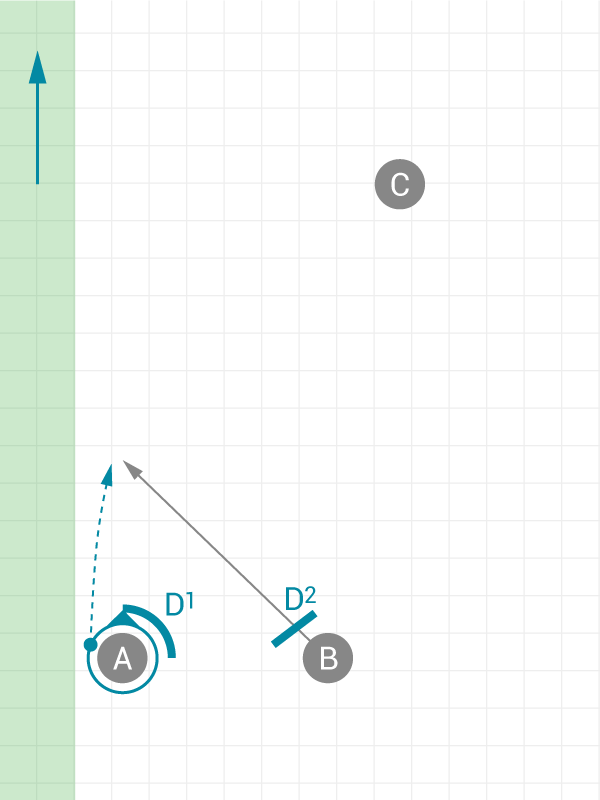
- 15 minutes: Drill: Sideline power position. This gets everyone throwing lead passes, with the option to throw continuation under or away to a cutter; this pattern will be something we’re aiming to achieve in the next drill and the game
- 20 minutes: Drill: Break side reset. This adds a defender to the reset and we encourage both defenders to play hard, realistic defence. The continuation cutter needs to time their movements well.
- 10 minutes: Mini: a game of 3-on-3 or 4-on-4 where the defence always forces towards the nearest sideline, aiming to put throwers into the trap position as often as possible
This kind of session works well when the coach wants players to improve one specific area without overloading them.
See the complete sideline resets session in Flik
Example 90-minute ultimate frisbee practice plan
A 90-minute session gives more room for progression. This makes it easier to move from technique to realistic application.
Sample objective: improve our deep throwing ability using a classic ‘triangle cutting’ progression
- 15 minutes: warm-up with mobility, activation, and throwing patterns
- 20 minutes: Drill: Triangle cutting drill – Under to Away for getting open deep and practicing throwing long passes
- 20 minutes:Drill: Triangle Cutting progressions: a game-based activity which expands on the first drill but introduces handler decision-making and the option of breaking the mark to space instead of hucking
- 30 minutes:conditioned scrimmage using isolated cutters to get lots of repetitions hitting defended cuts from a variety of angles
- 5 minutes: debrief and review of key coaching points
Longer sessions allow coaches to create a better learning arc. Players have more time to understand, repeat, and apply the core theme.
See the deep throwing to triangle cutters session in Flik

Ultimate frisbee practice plan for beginners
Beginner practices should prioritise clarity, repetition, and enjoyment. New players need to understand basic spacing, throwing, catching, and movement before advanced tactical concepts become useful.
Good beginner practice priorities
- Throwing and catching basics
- Running through catches
- Simple cutting timing
- Understanding where to stand
- Lots of touches and involvement
Example beginner session
- Warm-up with throwing and practicing catching
- Drill: Throwing in pairs. This gives us lots of simple repetitions throwing and catching
- A short game to get everyone moving and using their skills in a game context
- Drill: 50-50. This introduces the concept of catching under defensive pressure in a safe way.
- Game: Show. A way of expanding this catching concept in a larger group and developing hand-eye coordination while resting our legs before the game
- Another game, we’re hoping to see some better catches following the targeted drills
- Cool down & debrief
With beginners, avoid spending too long on static explanation. It is usually better to keep players moving and introduce ideas gradually.
See an example beginner’s session in Flik
Related: How to Play Ultimate Frisbee
Ultimate frisbee practice plan for intermediate teams
Intermediate teams usually need more work on decision-making, spacing, and coordinated movement. At this level, the goal is often to connect individual skills into better team play.
Good intermediate practice priorities
- Timing and spacing
- Handler and cutter coordination
- Continuation decisions
- Defensive positioning
- Applying skills under pressure
Example intermediate session
- Warm-up with throwing on the move and reaction work
- Drill: Sideline attack move. A drill related to initiating movement to begin sideline resets
- Game: Sideline trap in horizontal stack. A conditioned game that gets people comfortable in escaping a sideline trap in realistic situations
- Drill: Peppermill Flow. Practice cutting, clearing and timing to maintain flow in horizontal stack
- Conditioned scrimmage to 5 where we start from a sideline trap in horizontal stack each point
- Cool down & debrief
This is often the level where session design matters most. Coaches need to move beyond isolated drills and create practices that feel more like real ultimate.
See an example intermediate session in Flik based on creating flow in horizontal stack

Ultimate frisbee practice plan for advanced teams
Advanced teams usually already understand the basics. Practice plans at this level should focus more on precision, decision-making, system execution, and solving specific tactical problems.
Good advanced practice priorities
- Efficiency and detail
- Tactical clarity
- Decision-making at speed
- Special situations
- High-quality live reps
Example advanced session to help develop our break side continuation; this usually involves players catching, assessing the field and executing a throw very quickly and under defensive pressure
- Warm-up tailored to the tactical objective
- Drill: Offset lateral cut to get everyone moving, breaking marks, cutting and throwing continuation in a relatively simple scenario
- Drill: Breaking the mark to a cutter who then has to throw continuation under defensive pressure. This builds on the previous drill but is a harder progression
- Drill: Sideline wrinkle to practice getting the disc not just off the sideline, but to the far side of the field before the defence can recover
- Competitive scrimmage with narrow coaching focus, specifically rewarding teams who successfully hit continuation to the break side.
At advanced level, fewer activities often works better than trying to cover too much. High quality repetition around one clear objective is usually more useful than variety for its own sake. Because the players have more developed skills, there’s less emphasis on simple drills and more about putting players into game situations to let them work things out for themselves under pressure.
Here’s the full practice plan based on generating break side continuation, and you can see some of the diagrams below:
Step 01
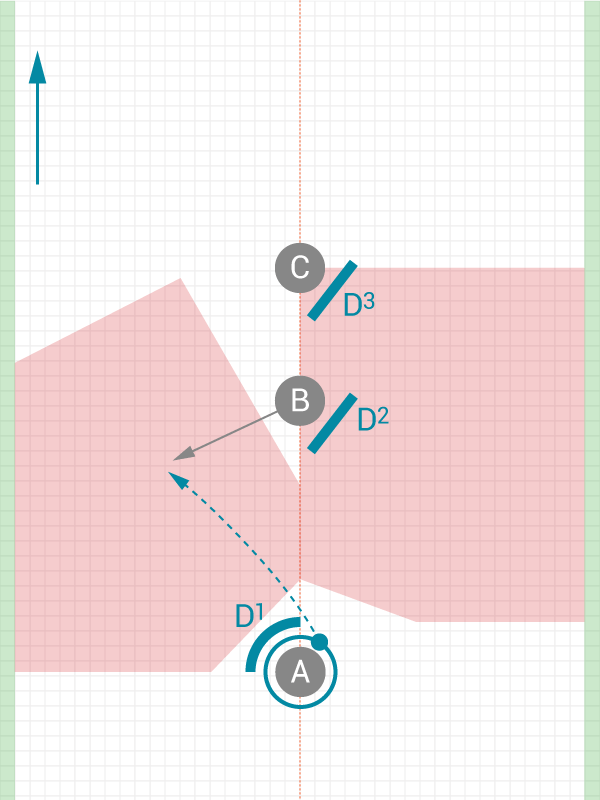
- Fig. 1: A breaks the mark to B
Step 02
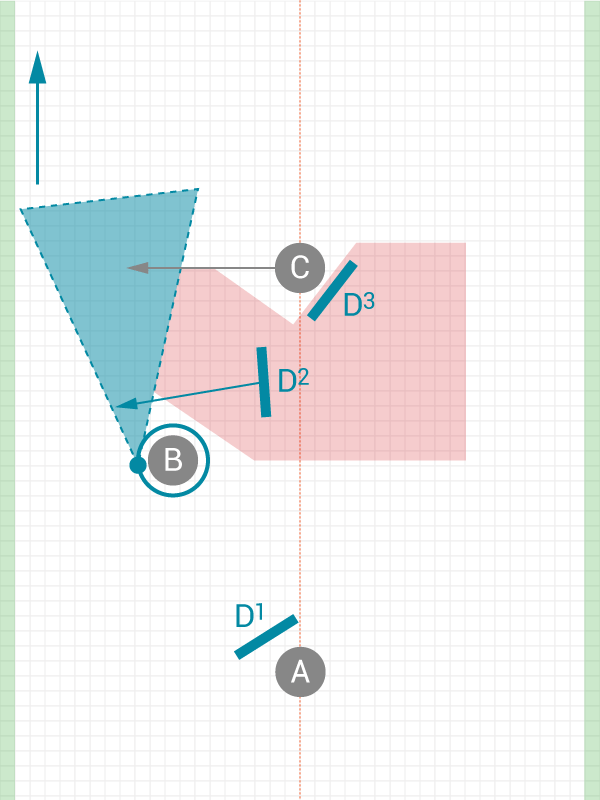
- Fig. 2: After breaking the mark, the downfield defender D2 is out of position; we're looking to exploit this temporary gap in coverage to sneak out a pass to the break side of the field without having to actively break the mark again
Step 03
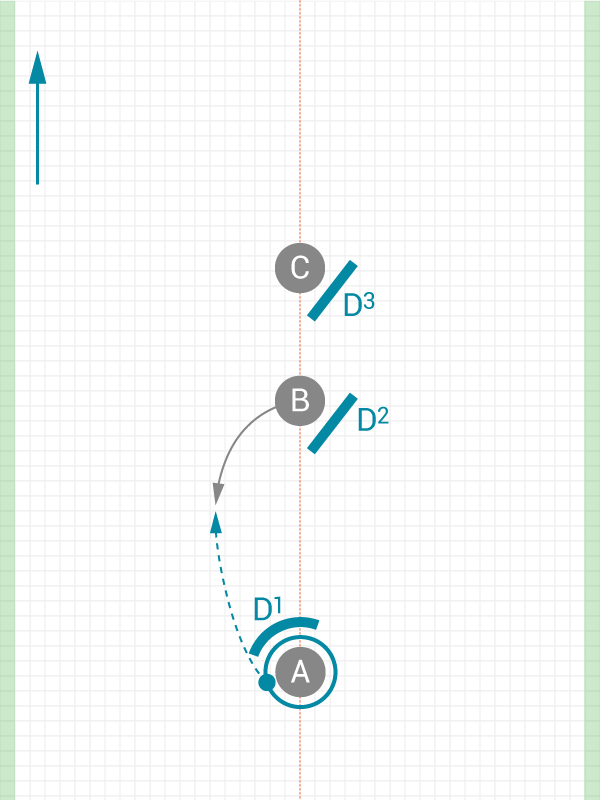
- Fig. 3: A underthrows B, forcing B to turn to attack the disc
Step 04
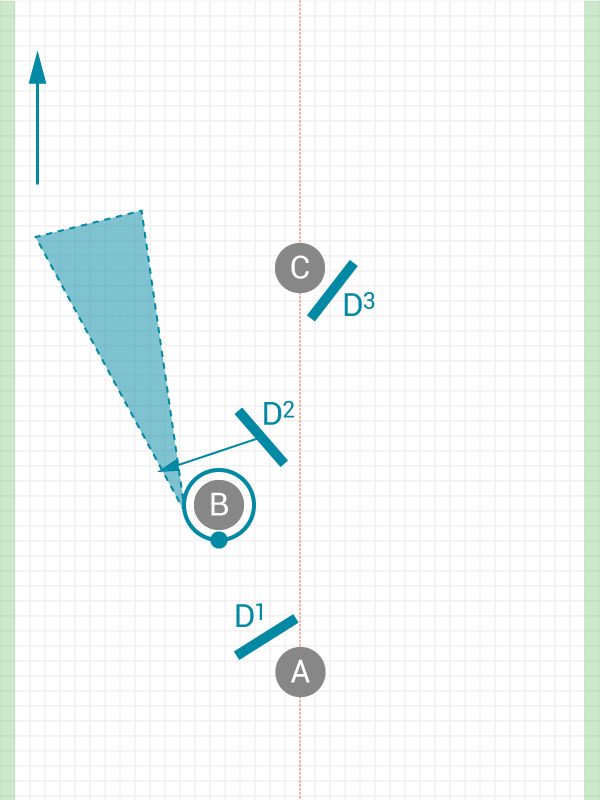
- Fig. 3a: B catches with back to the continuation cutter C. This makes it more difficult to throw continuation.
Step 05
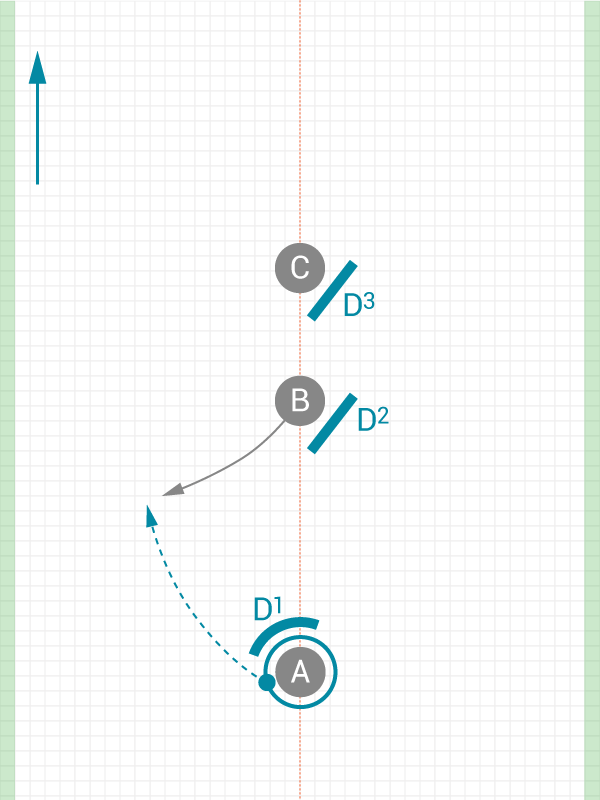
- Fig. 4: A throws wide to B; B turns to make the catch
Step 06
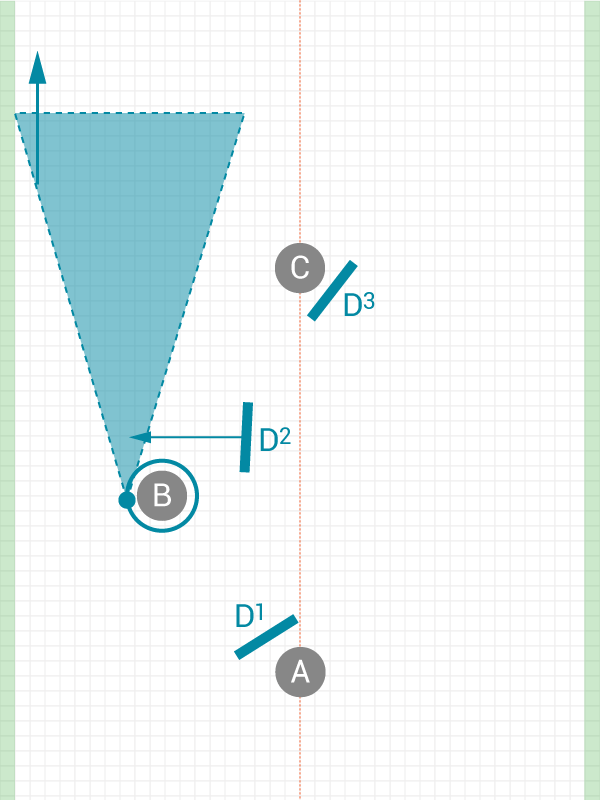
- Fig. 4a: A wider throw makes continuation easier
How to choose the right drills for your session
The best drill is not always the most complicated one. The right choice depends on your players, your objective, and where the drill sits within the session.
Ask these questions when choosing drills
- What exactly am I trying to improve?
- Is this drill suitable for my players’ level?
- Does it connect to real game situations?
- Does it fit logically into the session?
- Will players get enough useful reps and decisions?
For example, if the session is about beating person defence, you might start with a drill related to separation, then progress into a drill related to timing cuts, then finish with a game that rewards good spacing and decision-making.
Browse related drills: Ultimate Frisbee Drills
Common practice planning mistakes
Even good coaches sometimes build sessions that do not create much improvement. These are some of the most common mistakes in ultimate frisbee practice planning.
Too many unrelated activities
If the practice jumps between unrelated themes, players often leave without improving any one thing very much.
Drills that do not transfer to games
Some drills look organised, but do not teach useful decisions or realistic movement patterns.
Too much standing around
If players are inactive for long periods, the session becomes less efficient and often less enjoyable. Make sure you bring enough discs to enable players to keep moving as much as possible. The team that gets more repetitions should outperform their rivals, so a good coach aims to be efficient with team time.
Too much talking, not enough doing
Explaining is important, but players usually learn faster when they can practise and receive clear feedback in context.
No game play
If the session never returns to a game-like setting, players may struggle to use the skill outside of the artificial drill-like setting later and will be less likely to apply the skill during a real game.
How practice plans fit into a longer season plan
One practice can help, but repeated exposure over time is what creates reliable improvement. Good coaches think about how each session connects to previous and future practices.
For example, a team might spend several sessions building a theme progressively:
- Week 1: basic cutting timing and spacing
- Week 2: continuation flow after the first pass
- Week 3: attacking person defence with better shape
- Week 4: game-focused session reinforcing all of the above
This kind of progression is usually more effective than treating every practice as a completely new topic.
Related: Planning Practices
Example themes for ultimate frisbee practice plans
If you are not sure what to build a session around, these are some useful practice themes:
- Throwing and catching under pressure
- Getting open and continuation movement
- Handler reset offence
- Vertical stack timing
- Horizontal stack spacing
- Person defence fundamentals
- Help defence and communication
- Zone offence movement
- End zone offence
- Transition defence after a turnover
FAQ
What should be included in an ultimate frisbee practice plan?
A good ultimate frisbee practice plan should usually include a warm-up, one or two focused skill sections, an applied drill or game-based activity, and a scrimmage or conditioned game that reinforces the theme.
How long should an ultimate frisbee practice be?
Many ultimate frisbee practices last between 60 and 90 minutes. Shorter sessions usually need a tighter focus, while longer sessions allow more progression from technical work into live play.
What is the best ultimate frisbee practice plan for beginners?
The best beginner practice plans focus on throwing, catching, movement, spacing, and simple game play. New players usually improve fastest when they get lots of touches in clear, enjoyable activities.
How many drills should be in one ultimate practice?
Most good practices only need a small number of well-chosen activities. Two or three connected drills plus a game-based section is often more effective than trying to fit in too many unrelated exercises.
Should every practice end with a scrimmage?
Not necessarily, but most sessions should include some form of live or conditioned play. This helps players apply the theme in realistic situations.
How do I make my ultimate frisbee training sessions more effective?
Choose one clear objective, build the session logically from simple to complex, use drills that transfer to real games, and make sure players spend enough time making useful decisions under pressure.
Related Guides
- How to Play Ultimate Frisbee
- Ultimate Frisbee Drills
- How to Get Open in Ultimate Frisbee
- How to Beat Zone Defence in Ultimate Frisbee
Flik helps coaches build better ultimate frisbee practice plans with structured drills, session ideas, videos, and theory.
Comments