Things to consider when guarding handlers: When face guarding handlers works by Brummie

Loading table of contents - please wait.
Anyone who watched the 2026 WJUC open final between Canada & USA will probably have remembered the commentary team – Liam Grant & Tom Styles – being critical of USA’s handler defence, particularly regarding face guarding and how they need to be able to see the disc as much as possible if they want to be able to get a block. Here’s the clip; pop the sound on if you want to hear the original comments:
I do agree that the defence being played was ineffective… just not necessarily because of face guarding. I think it was ineffective because of poor positioning. Face guarding itself isn’t necessarily the problem; what matters is what space the defender is taking away, what space they’re conceding, and their awareness of the disc. The problem isn’t whether you’re looking at your matchup or the disc. The more important question is whether your positioning takes away the offence’s most dangerous space.
I’ve taken a freeze frame at the point in the clip above immediately before the pass which leads to the goal, aka the “hockey assist”. I’ve drawn a line halfway between offence & defence, and a circle showing approximately where the disc was caught; notice how the circle is on the Canadian side of the line:
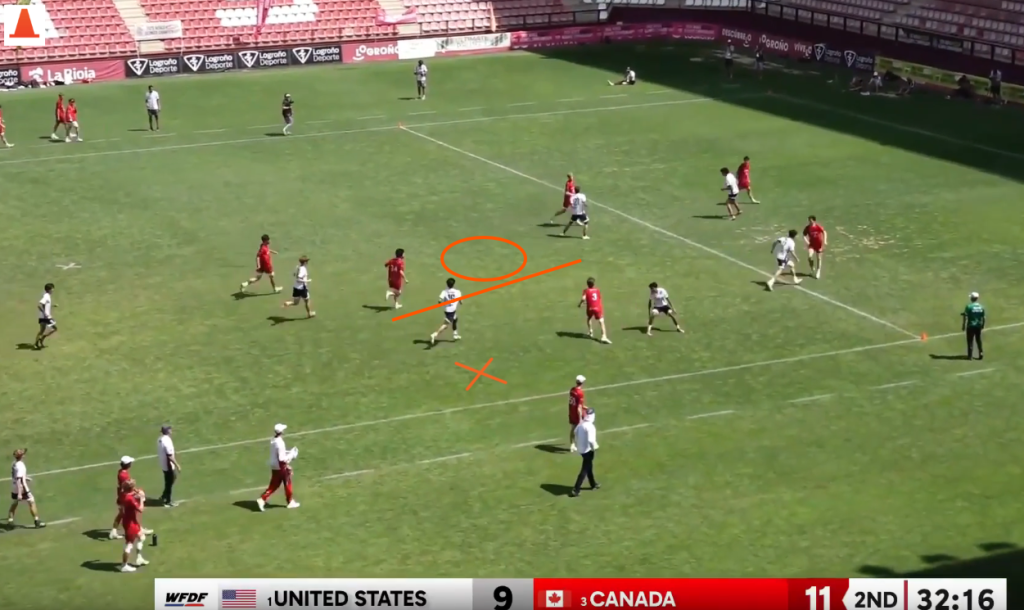
Defenders use their bodies to deny space, so the important question is: do Canada actually want the disc in the space this defender is taking away (marked ‘X’)? I would say no: such a throw would be directly behind the thrower, near the sideline and with the lane in front of the disc already clogged (remember this for a later example where a defender achieves exactly that). If I were coaching this defence, I’d want the defender between the cutter and the end zone, using his body to deny the leading pass.
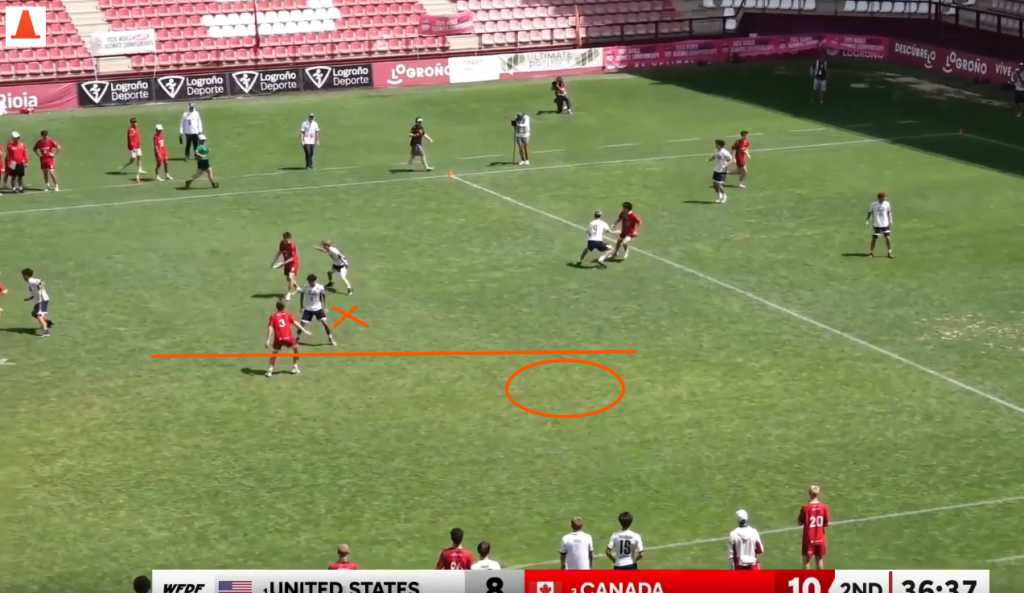
As another example, here’s the clip from a few points previous which sparked the conversation about face guarding:
If we freeze frame immediately before the throw, again we can see the dangerous space that USA give up is beyond the line separating the receiver and defender; if the thrower can put the disc past the defender, Canada generate Power Position and are able to attack the end zone immediately. Compare that to the space the defender is currently blocking (‘X’ on the image); while there’s some risk that the reset gets a chisel cut (see Chisel) with break side continuation, the amount of space here is very small compared to the much bigger threat of power position:
USA were caught doing the same thing elsewhere in the game too; there are three examples in this clip alone:
There are plenty of other examples in the game – and lots of good handler defence too! – but these examples illustrate the talking point that Liam & Tom agreed on. But were they right?
Face guarding done right
If face guarding is inherently a problem, though, we should expect elite reset defenders to avoid it. They don’t. Let’s look at some great face guarding. Anyone who saw the WMUCC Open Final between Clapham & Boneyard will certainly remember one of the big plays of the game being Brett Matzuka making a phenomenal catch in a crowd after being shut down by Phil Garner. A few moments later, Boneyard turn the disc throwing a reset due to a miscommunication caused by some excellent reset defence from Connor McHale:
It should not have escaped your attention that both Garner and McHale spend much of this sequence face guarding their resets. Clearly face guarding can be effective. Neither, however, treats it as a rule they have to follow rigidly: both steal looks at the thrower when they judge they can do so without losing their matchup. Facing your matchup is sensible for lots of reasons. You can react faster to their movements, while having your hips pointing towards them leaves you ready to give chase if they set off – something covered in Four mistakes to avoid when defending deep cuts.
Phil Garner is one of the unsung heroes of Clapham’s decade of European dominance, quietly causing chaos in the opposition handler set for years. He might not have always made the big plays, but he’s an expert at locking onto the opposition’s best throwers and making their lives difficult. He’s the one playing incredibly tightly to the reset at the start of the next clip, showing how an effective face guarding position can be when you use your body to deny one area of the field. Notably though, his head is rotated slightly, allowing him to see the thrower without losing sight of his person:
I wrote to Phil to get his insights on some of these clips, the first of which is early in the game. Just watch Phil’s movement, moving from very tight to giving a buffer and back again, constantly repositioning and reassessing the situation.
My observations:
- when on the mark, Phil drops to create a buffer immediately after the disc is released; this helps to guard against the give & go
- when the disc is in the middle, notice how Phil puts his body between the reset and the end zone to guard against power position; exactly what I highlighted in the Canada clip earlier
- as the reset becomes active and gets ready to cut, Phil takes a closer position, blocking the upline cut with his body. This works for the first move, but he bites on the head fake and the reset runs upline without getting the disc
- Phil adopts a different position once his matchup is acting as a cutter, but face guards throughout the rest of the point
Phil: “Here I’m marking someone who always wants to be around the disc so I’m aiming for him to be pushed downfield, so here I take an aggressive position on the disc side throughout the cut. I time exactly when I step into the tight aggressive man D position just at the time when I get a read he is about to make a cut. I play with the distance during points and during the game to try and generate some confusion and not create a pattern. I do slightly bite on the cut back to the handler space knowing who I am marking, but am able to keep the reset covered for the line cut (whilst leaving a loopy line throw, which is likely to be into other players / the stack).”
Later in the game, Phil was guarding a reset on the sideline. Initially, he face guards with his back to the end zone, but as the stall count rises and the reset moves backwards, Phil slowly rotates to face the sideline. This doesn’t give the thrower any useful places to reset other than backwards into a space the offence is already trapped on the sideline:
Phil: “This was situation specific and an adaption made to a handler who was always wanting to be around the disc, a moment where he set up behind the disc, and a tight space between handler and reset, making a thrower-led reset (a ‘German’ throw to space) more likely than waiting for the handler reset to initiate movement. Facing and seeing the disc changes that and can create some hesitation or confusion. Facing away leaves experienced handlers with the option for a leading disc into space”
A key point here is that Phil assessed the situation he was in and fully expected the type of thrower-led pass to space that Canada used above, but he used his experience to adjust his position and make such a throw less likely to be successful.
In the final clip, Phil’s default position is to block the reset from attacking downfield and generating power position, making the types of leading passes that Canada used above more challenging & less damaging to the defence. Note also Phil’s interesting footwork, choosing to turn his hips to face the thrower when he thinks there’s a risk of an upline cut. When he turns his back on the reset, Phil has to constantly swivel his head to maintain awareness. His positioning ultimately encourages the reset into the space directly behind the thrower; as I mentioned earlier, this isn’t a place that offers the offence anything advantageous. As Dylan Freechild said in his excellent guide Defending sideline resets: “The goal here is to usher the dump into the space directly behind the thrower by conceding it initially and never overplaying it. Either the dump gets the disc on the sideline or the sideline acts as an eighth defender and the dump runs out of space to cut to.”
Phil: “The shift here allows me to see the disc and the thrower whilst keeping an eye on the reset handler. At this short range and behind the disc (making the line cut challenging) this can create some hesitation for the thrower whilst keeping close to the reset. Against experienced players at this level some variation is important, as they are likely well drilled on the ‘by the book’ set up and able to adapt if you show them a specific style of defence for the whole game. Also, I did get the point block here. I knew he was my matchup for the game and watched him throw as much as I could pre-game to get an idea of his typical throwing height.”
Garner is describing defensive variability as a deliberate tactic. He’s manipulating:
- distance
- orientation
- his ability to see the disc
- which space he concedes and what he takes away
- timing of pressure
Good reset defence isn’t necessarily about finding one technically perfect position and repeating it. Against experienced handlers, predictability itself can become a weakness. Garner varies his positioning according to the disc, the stall, his matchup’s tendencies and what he’s already shown them. This leaves his opponents less certain about what he’s going to do, potentially creating hesitation on the reset. Phil’s point about researching his matchup’s release points is also an important one for anyone who habitually guards handlers.
Overall, I think face guarding isn’t as bad an idea as Liam & Tom made it sound, but they were right that understanding the disc’s position is an important factor in playing good reset defence. Sometimes looking at the disc is valuable. Sometimes keeping complete visual contact with your matchup is more valuable. The important thing is that the defender understands what they’re trying to prevent and positions accordingly. The lesson isn’t that defenders should face guard, or that they shouldn’t. It’s that orientation should be a consequence of what you’re trying to defend. Identify the most dangerous space, use your body to proactively deny it (see Anticipating handler movements), and then gather as much information about the disc as you can without compromising that job.
One thing I haven’t mentioned so far is team communication, but mostly because it would be guesswork on my part what kind of defensive communication is in place. Every elite team I’ve been part of has used their sideline to communicate to defenders, and this can help to bridge the gap where face guarding might result in a player not knowing where the disc is, or when the thrower is looking at them. A strong defence works as a unit, and communication is a big part of that.
Thanks to Phil Garner for sharing his insights with us.
Comments